Horizon Publishing Company
 DOW Theory Forecasts
 Upside
 Horizon Investment Services





Given the Dow Theory Forecasts’ focus on individual stocks, you can understand why we typically talk about income from a stock standpoint. But this week, we reach out further.
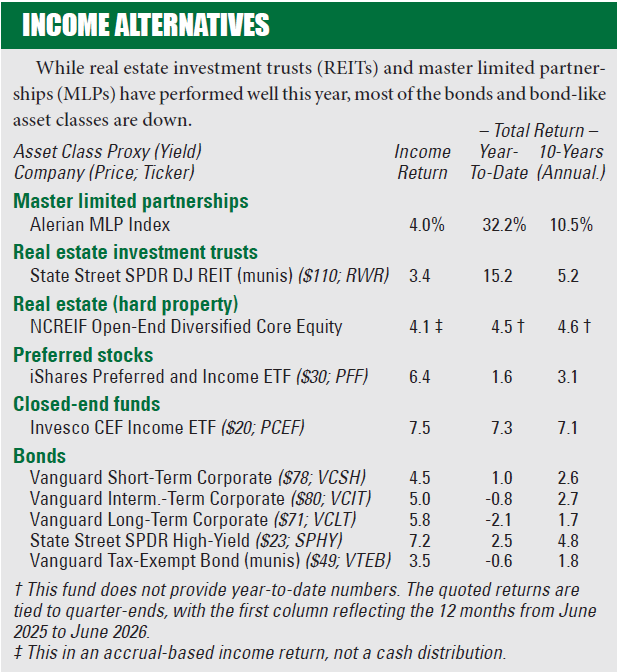
We know many of you invest with income in mind, and for that reason you like to dip a toe (maybe a lot more) into alternative investments. Some of these asset classes perform a lot better than others. Check out the table below for a comparison.
Equity options, such as real estate investment trusts (REITs) and master limited partnerships (MLPs), have enjoyed a good year, while the CEF S-Network Composite, which invests in real property, rose 5% from June 2025 through June 2026. In contrast, most of the bonds and bond-like securities are down for the year, and over the last decade — even taking dividends into account.
Of course, bonds provide an additional benefit, diversification of equity-heavy portfolios. Admittedly, diversification does not sound like anything special when stocks are soaring. But a bond position blunts the effect of ugly downward moves in equities, albeit at the cost of underperformance during strong stock markets.
In the following paragraphs, we play some pro versus con regarding a few intriguing alternative-income sources. Keep in mind that we do not follow most of these asset classes regularly and thus will not track most of the securities in the tables below and on page 5. Visit www.DowTheory.com to find our recommended fund portfolios and our Alternative Income Watch List, which focuses on REITs and MLPs.
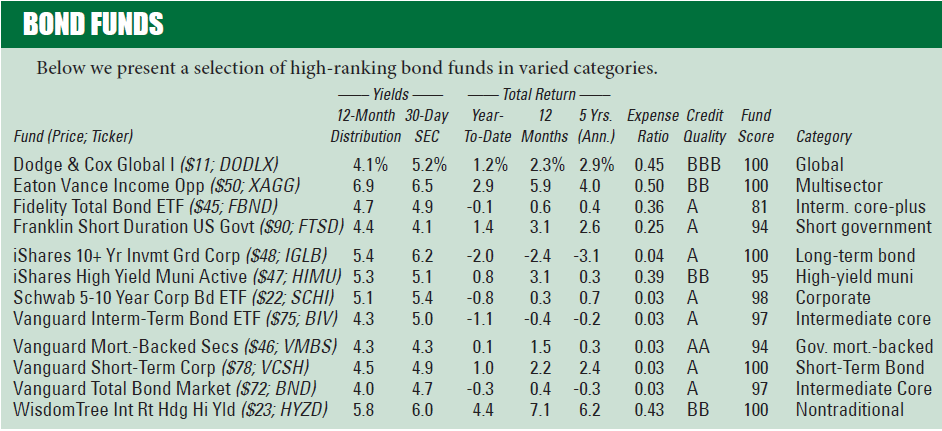
Bond funds
Pros:
 Most popular income vehicle for individual investors, with U.S. citizens holding $8.2 trillion.
Diversification benefits relative to common stocks.
Thousands of options in dozens of categories.
Higher yields and less volatility than stocks.
Cons:
Underperform stocks over the long run.
Consistent tax liabilities, unless held in tax-protected accounts.
Sensitivity to interest rates.
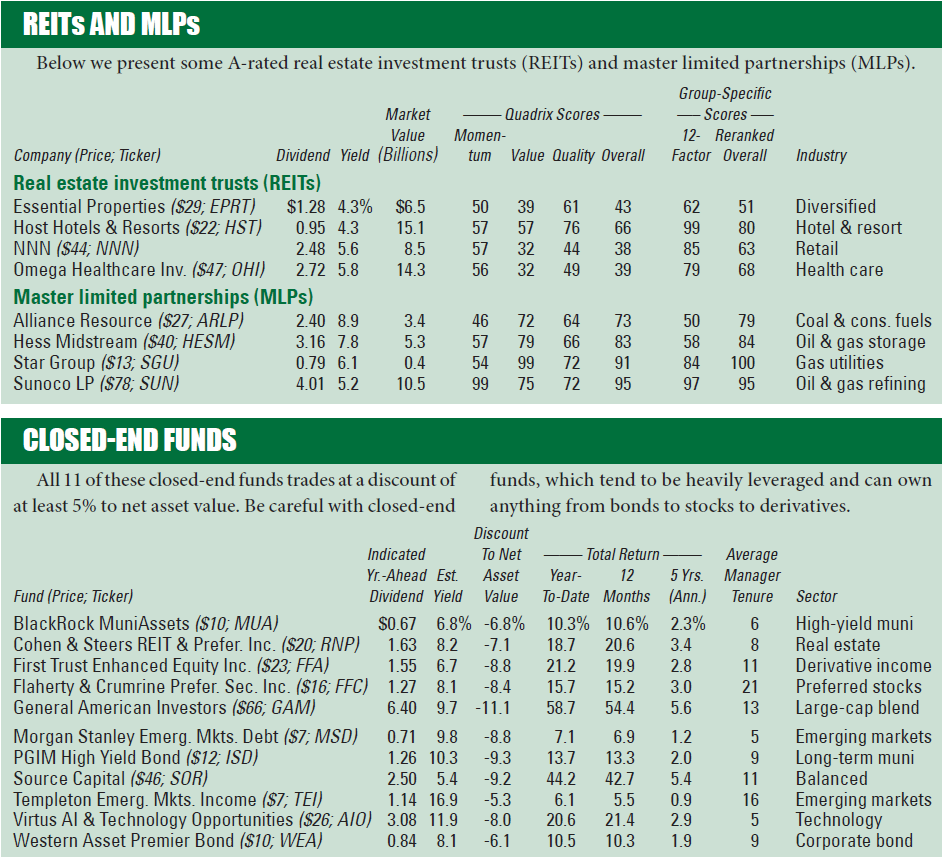
REITs and MLPs
Pros:
Generous yields.
Trade like stocks, with excellent liquidity.
Better growth potential than fixed income, and superior long-term returns.
Cons (REITs):
Just a small slice of the market (real estate).
High sensitivity to interest rates.
Special tax treatment required for some dividends.
Cons (MLPs):
An even smaller slice of the market (mostly midstream energy
Moderate sensitivity to interest rates.
Form K-1 required at tax time.
Real property
Pros:
Offsets taxes with depreciation.
Usable as collateral for loans.
Cons:
High initial investment.
Illiquid, and concentrated in one market segment.
Complicated to manage, with higher carrying costs (management or maintenance) than financial securities.
Preferreds
Pros:
Generous yields.
Relatively low volatility.
Can qualify for lower tax rates.
Cons:
Sometimes take hits in bad markets like stocks, yet act more like bonds at other times, including the lack of growth and high interest sensitivity.
Tougher to trade and track than common stocks.
Limited upside because of call risk.
Closed-end funds
Pros:
Yields averaging more than 7%, mostly because these funds often trade at discounts to net asset value (NAV).
Special permanent capital structure that allows them to own many types of assets, including some unavailable to mutual funds.
Cons:
Complicated and expensive to own.
Low growth on average, though rates can vary widely from fund to fund.
Messy taxes because of return of capital.
High interest-rate risk.